
Operators, not Graduates
Why missionary preparation keeps producing the wrong result, and what fighter pilots can teach us about fixing it
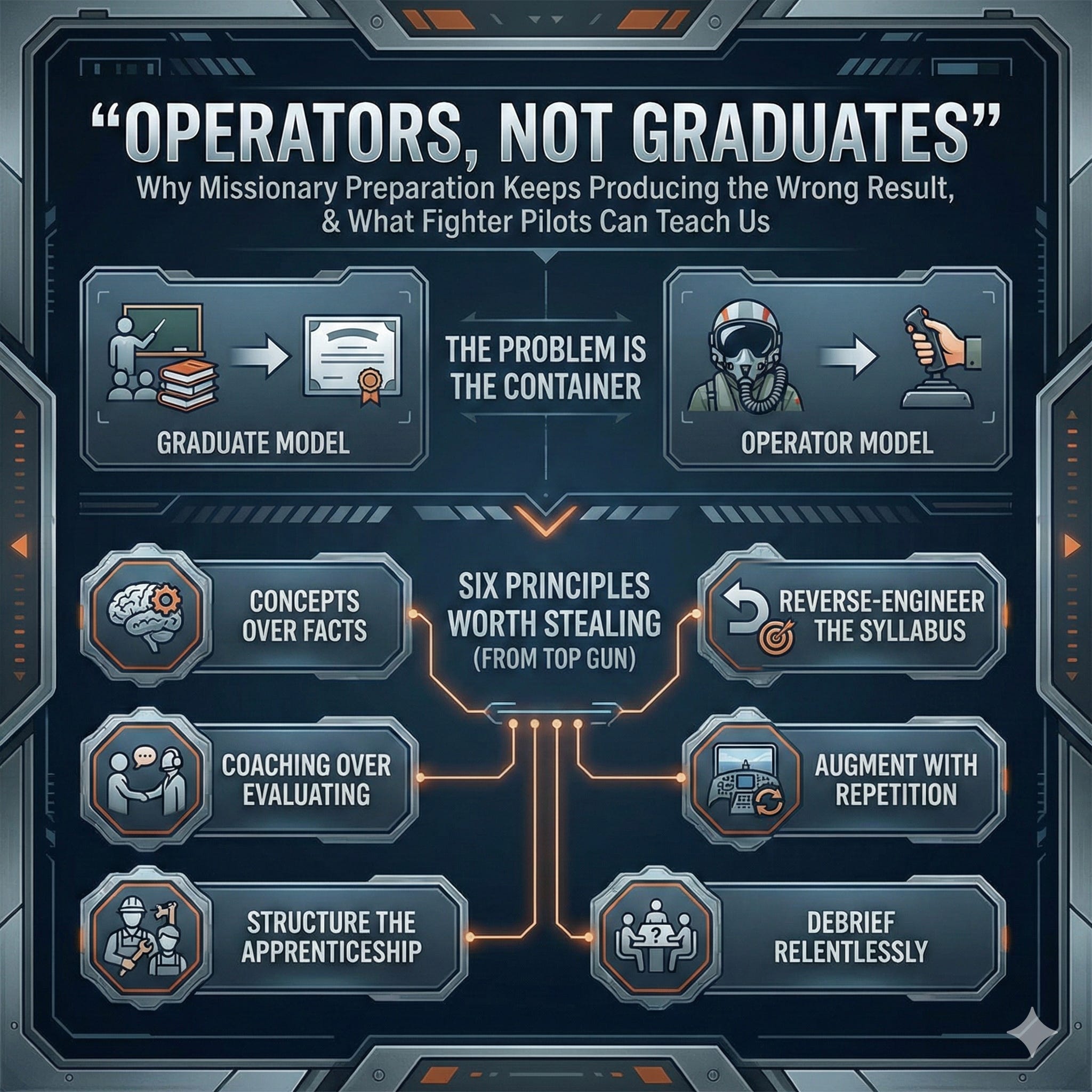
In the 1980s, the U.S. Navy faced a crisis. Despite superior technology, their pilots were losing dogfights. The solution was not more classroom time. It was Top Gun.
The Navy stopped treating pilots as students and started treating them as operators in training. This was not a minor curriculum update. It was a total professional reckoning. A shift from teaching “about” flying to forging the person in the cockpit. In a dogfight, you do not have time to consult a syllabus. You have seconds to process data and act.
Global missions face an identical crisis today. We have largely avoided the reckoning.
The Pipeline We Inherited
Missionary preparation is a multi-stage pipeline: local churches form character, seminaries build the theological framework, and mission schools attempt to “finalize” field readiness.
Every stage reflects the assumptions of the one before it. The people designing these systems grew up in legacy models of theological education. They learned well, so they teach what they know. This is how systems reproduce their own DNA. The classroom model is an inheritance, not a conspiracy. But that inheritance keeps producing missionaries who are theologically informed and operationally underprepared.
The problem is not the content. It is the container.
Training for the G-Force
Most missionary preparation is front-loaded. Candidates absorb massive amounts of information before they hit the ground. Then they arrive on the field, and reality begins dismantling everything they “know.”
Information delivered before the experience does not stick the same way as knowledge built inside the experience.
We are shaping missionaries like academics when we need to be shaping them like operators. The dogfights of cross-cultural ministry happen in living rooms and marketplaces, not lecture halls.
If the training does not move from the head to the hands through the heart, it has not actually happened.
I work in data. But in my bones, I am a strategic equipper, and I have spent years developing curriculum for practitioners. The wall I kept hitting was this: you can explain a concept clearly, model it carefully, move immediately to application, and still watch it evaporate the moment someone hits real pressure in a real context. Good information is not enough. It has to be forged into judgment.
Six Principles Worth Stealing
The Navy redesigned pilot training around principles that map directly onto the challenge of reaching the unreached.
Concepts over Facts. Top Gun asks pilots to internalize principles that hold under pressure, not memorize manuals. A worker who can recite contextualization theory but freezes in a real relational moment has facts, not concepts. The goal is judgment, not recall.
Reverse-Engineer the Syllabus. Build training around the actual situations workers will face, not what is convenient to teach. What are the real scenarios your people will encounter in their first six months on the ground? Start there. Build backward from the field, not forward from the textbook.
Coaching over Evaluating. Evaluation tells you where someone is. Coaching moves them forward. Operators need coaches, not just assessors.
Augment with Repetition. The Navy used flight simulators to give pilots thousands of repetitions before they entered a real cockpit. Use technology and role-play to build muscle memory before the stakes are high.
Structure the Apprenticeship. The most durable learning in missions history has always been apprenticeship. It must be the critical path, not an optional nice-to-have.
Debrief Relentlessly. Pilots spend more time debriefing than flying. That is where the actual learning happens. Mission teams need protected rhythms to ask: What happened? What did we expect? Where is the gap? This is a requirement, not an afterthought.
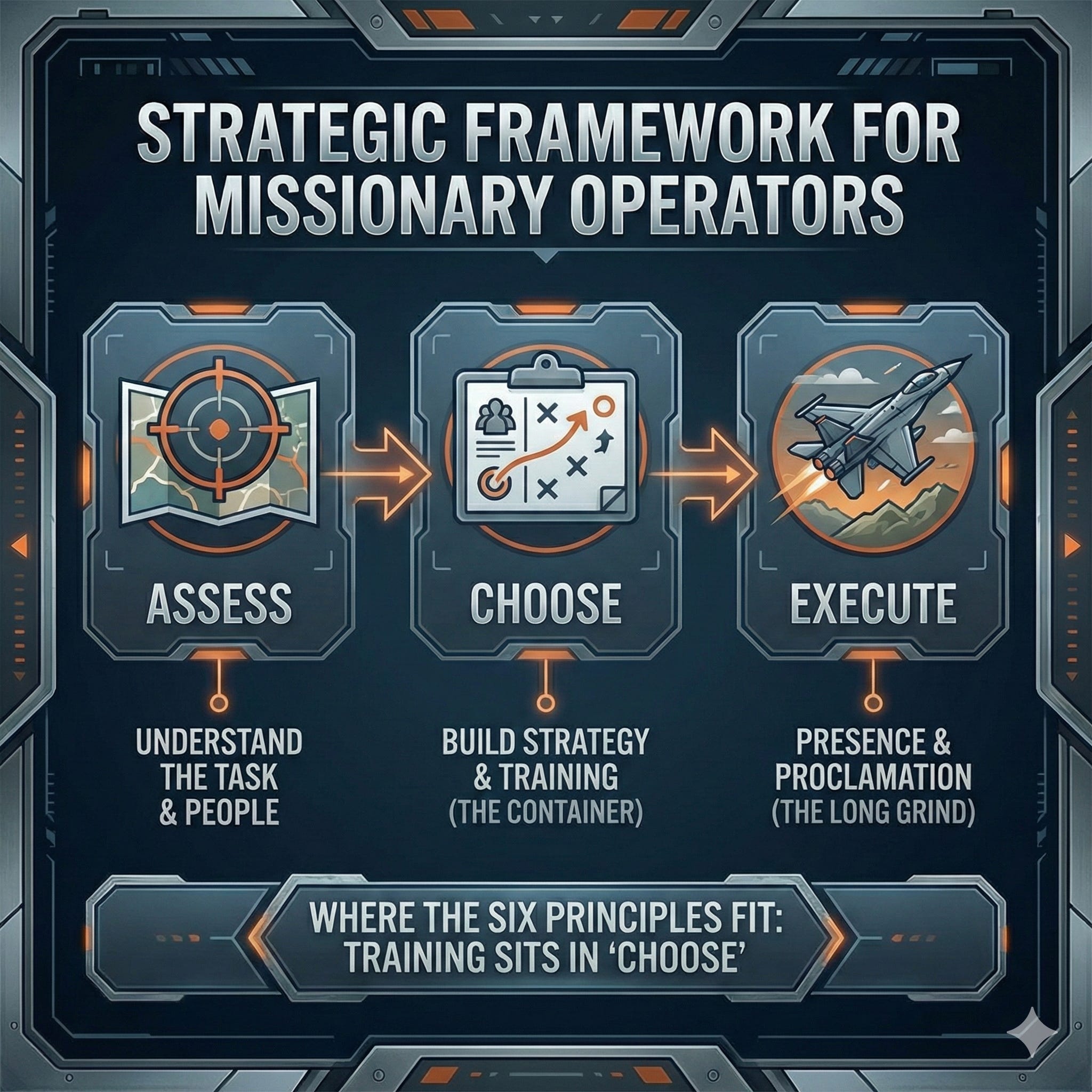
Training sits in Choose because what gets decided here shapes everything downstream. Bad training does not fail immediately. It fails slowly, under pressure, far from home, in situations no classroom anticipated.
But here is what sharpens the stakes:
Choosing a training model is a theological decision. It reflects what we believe about the human person. Are they a bucket to be filled with information, or an image-bearer to be forged for a task?
You cannot build a perfect curriculum for a dogfight from a conference room. You build a system that learns from what happens in the air and updates accordingly.
The Problem Beneath the Problem
There is one more layer worth naming.
The classroom model does not just reflect poor pedagogy. It mirrors consumer culture. You show up. You receive content. You get certified. You move on. It is passive. It is transactional. It is consumptive.
The same formation that makes consumer culture feel normal has quietly shaped missionary preparation. And the missionaries most likely to walk away from the field are often the ones whose training never challenged that posture. [I’ve written about that connection here.]
For now, look at your pipeline and ask one question:
Are you producing operators or graduates?
The unreached world does not need graduates, consumers, or tourists. It needs ambassadors of Christ who have been equipped, coached, and forged to stay.
Want to talk more about equipping? Interested in using data to track your equipping process? Send me a message!
So good bro!
Every Disciple maker needs to read this!