
Pattern or Principle?
Three tests for reading Jesus, Paul, and the early church strategically
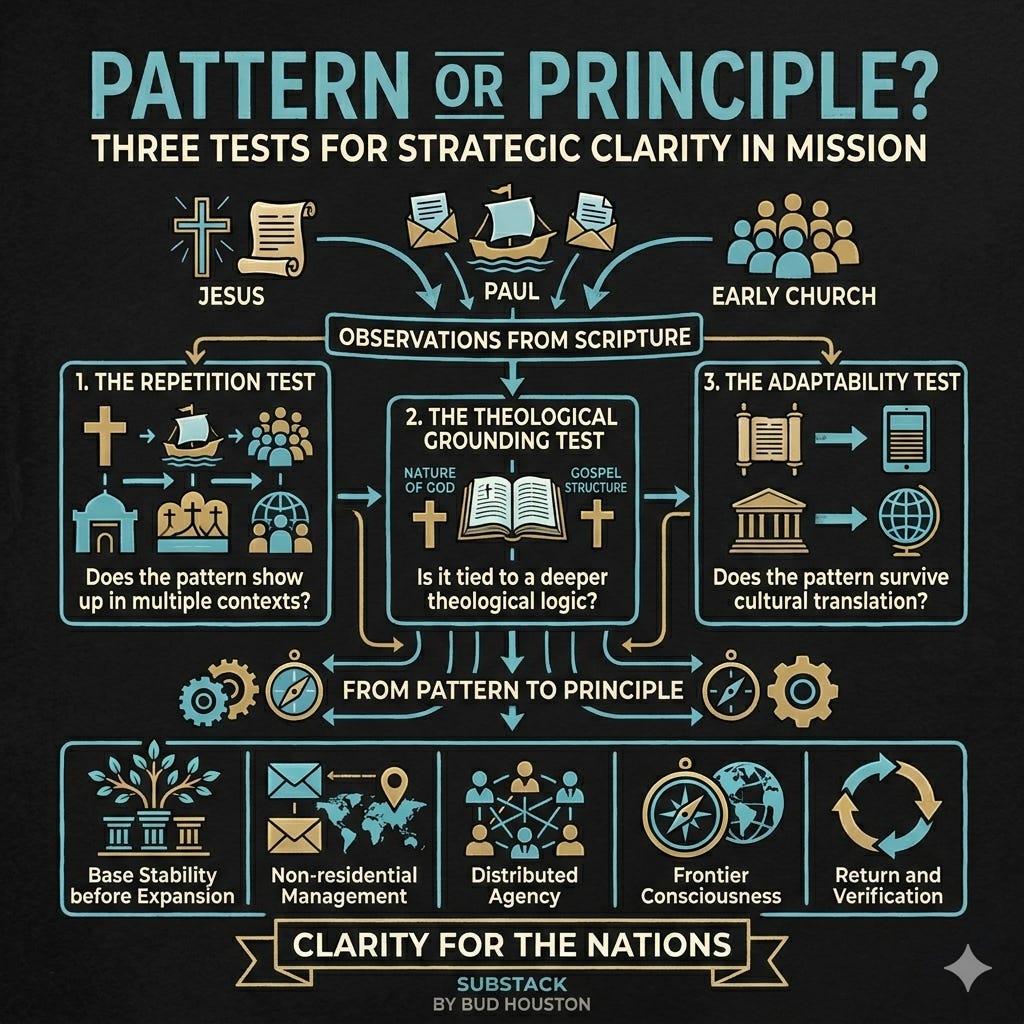
Image Generated with Nano Banana
There is a hermeneutical move that ruins more missions strategy than any other. It goes like this: “Jesus did X. Therefore we should do X.” Or its twin: “Paul did Y. Therefore Y is biblical.” Both treat observation as a principle without asking whether the pattern in front of us is a transferable strategic logic or a culturally conditioned application of something deeper.
The two previous articles in this series examined how Jesus and Paul managed multi-node engagement portfolios. That is observation. The question this article addresses is when, if ever, those observations rise to the level of binding strategic principle for modern practice. And if they do, what form they should take when the cultural context has changed.
Three Tests
A pattern in Scripture passes from observation to principle when it survives three tests:
The Repetition Test. Does the pattern show up in multiple actors across different historical and cultural contexts in Scripture? A pattern that appears only once may be significant, but it is more likely an account of something that happened than a prescription of something that must happen.
The Theological Grounding Test. Is there an explicit theological logic behind the pattern, or is it tied to local convenience? A pattern grounded in the nature of God, the posture of the gospel, or the character of mission carries weight that a culturally-bound preference does not.
The Adaptability Test. Does the pattern survive translation into a different cultural form? A principle is something that holds even when the surface practice changes. If the pattern only works in first-century Judea or first-century Greco-Roman cities, it is probably a culturally-bound application rather than a transferable principle.
A pattern that passes all three is operating at the level of principle. A pattern that passes one or two is suggestive. A pattern that fails all three is descriptive history rather than prescriptive strategy.
Recapping the Multi-Node Strategy
The first article examined how Jesus managed a four-node portfolio across the Gospels. Judea was where the movement first multiplied and where Jesus withdrew, under pressure from surveillance, to select Galilee as his base of operations. Galilee became the primary node where disciples were trained and ministry multiplied through them. The Decapolis was activated non-residentially through a single local insider, the healed Gerasene man, with Jesus returning later to verify advancement. Jerusalem operated by entirely different logic: a high-resistance strategic node engaged repeatedly but never baselined.
The second article examined Paul’s multi-node strategy. Forced exits from Thessalonica and Philippi shaped his non-residential management system of letters and the deployment of co-workers like Timothy and Titus. Longer stays at Corinth (18 months) and Ephesus (3 years) reflected a higher threshold: not a single congregation but a reproducing community capable of regional propagation. Ephesus served as a hub that produced local insiders like Epaphras, who carried the gospel to places Paul never personally visited. Spain represented a Phase 0 frontier where the eastern model’s assumptions would not transfer.
The Principles That Emerge
When we run the multi-node strategies of Jesus and Paul through the three tests of repetition, theological grounding, and adaptability, several clear principles emerge.
Sufficient base stability before expansion. Jesus did not cross to the Decapolis before his Galilean movement was multiplying through trained disciples. Paul did not move on from a city when he had operational freedom until the church had demonstrated reproducibility. The pattern repeats across actors. It is theologically grounded in the gospel as a reproducing community rather than a single event. And it transfers across cultures. The most durable indigenous movements of the last century have repeatedly converged on the same logic across very different contexts.
Non-residential management of nodes you cannot reach in person. Jesus left a local insider with a clear mandate. Paul wrote letters and sent envoys. The early church continued this logic through itinerant teachers, leaders establishing a presence in multiple cities, and the rapid distribution of apostolic correspondence. The form changed across centuries. The principle held: when you cannot be present, build systems that continue to advance the community without you.
Distributed agency over personal presence. Jesus operated through the Twelve and the Seventy. Paul operated through a named network of co-workers. The post-apostolic church continued through elders established in every city. The pattern repeats. It is grounded in a theological vision of the church as a body with many members rather than a single charismatic figure. And it transfers: movements dependent on a single leader are fragile in every era. Movements with distributed leadership reproduce.
Frontier consciousness. Jesus engaged the Decapolis. Paul planned Spain. The early church spread across the Mediterranean basin within a generation. None of them treated their current node as the final destination. The pattern is consistent. It is grounded in the universality of the Great Commission. And it transfers:
Every healthy missions strategy in every era keeps the unreached frontier in view, even as it invests deeply in current work.
Return and verification. Jesus returned to the Decapolis. Paul revisited churches and sent envoys. The early church developed regular oversight structures. The form varied. The pattern that nodes need follow-up assessment, not just initial activation, holds across all three eras.
The principles that show up in Jesus and Paul did not depend on either of them personally. The logic was the strategy.
Continuation in the Early Church
The patterns did not stop at the end of Acts. Antioch continued as a launching point for missionary expansion. The Jerusalem council demonstrated distributed governance across a regional network. The expansion of Christianity through merchants, slaves, soldiers, and family networks across the Roman Empire reflected the same insider-led, multi-node logic that Paul had modeled. Elders were established in each city as Titus 1:5 had prescribed. Apostolic letters circulated among churches as the canon itself testifies. Alexandria developed a formal catechetical school under Pantaenus, Clement, and later Origen, and theological centers like it served as hubs for the concentrated formation of emerging leaders.
When a pattern passes the three tests, it does not depend on the original actor. It reproduces because the logic is sound, not because the people were uniquely capable.
Same Principle, Different Forms
This is where modern application requires care. A biblical principle is not a fossilized practice. It is a strategic logic that takes different forms in different contexts.
Non-residential management looked like a letter delivered by a trusted courier in the first century. It looks like a monthly video coaching call in 2026. The principle of continued advancement when physical presence is impossible holds. The form changes.
Distributed leadership looked like a named team of co-workers in Acts. It looks like a network of indigenous local elders in modern frontier work. The principle that multiplication requires shared agency holds. The form changes.
Base stability before expansion resembled Phase 6, reproducing communities in Paul’s eastern Mediterranean. It looks like a movement of multiplying disciples in a modern oral preliterate context. The principle that what you leave must be able to sustain itself holds. The form changes.
The mistake is to treat the form as binding. The bigger mistake is to assume the absence of the form means the absence of the principle.
A WhatsApp group of village leaders and the Ephesian network of local insiders are operating on the same strategic logic. A digital coaching call and a hand-carried letter are doing the same work. The form has changed by 2,000 years. The principle has not.
Frontier consciousness looked like Jesus crossing to the Decapolis and Paul looking past Rome toward Spain. It looks like an agency pulling resources from already-reached fields to reallocate toward unengaged peoples and unreached geographies, even when the established field is more comfortable to maintain. The principle that the current node is never the destination and that maturity is a signal to move toward the unreached peoples and places. The form changes.
Return and verification looked like Jesus tracing an unusual route back through the Decapolis and Paul revisiting churches through envoys and letters. It looks like a structured assessment cycle measuring health, scope, and reproductive capacity of nodes seeded years earlier, rather than simply reporting that the work continues. The principle that initial activation requires follow-up evaluation holds. The form changes.
Writing briefly on theological concepts invites criticism for lack of nuance or specific particulars. The intention of this article (and most of my articles) is to help people think in a helpful direction.
Questions for Your Team
Which patterns in your current strategy are you treating as principles when they are actually culturally-conditioned applications imported from a context that does not match yours?
Which biblical principles are you ignoring because the form you are familiar with does not exist in your current context? Are you waiting for a synagogue that will never appear, instead of asking what plays the structural role of a synagogue in your geography?
When a pattern in your strategy fails the repetition test, the theological grounding test, or the cultural adaptability test, are you willing to release it and ask what the underlying principle actually requires in your context now?
Bud Houston serves as Director of People Group Data at Joshua Project and writes Clarity for the Nations on Substack.
 | A guest post by
|
Great work Bud. Give me a simple definition of 'node'. Is it "ministry location"? Or something deeper than that?
I see Jesus as the only perfect model. Paul and others were leaders in formation (Making of a leader, Clinton) and repented and slowed down into the Jesus model. If that’s true, it makes patterns nuanced echoes of Jesus wherein we need to be careful to qualify repetition as evidence of principle.