
View an interactive version of this article here: https://4thenations.com/the-sending-force-is-already-next
If you want to understand the future of missions in Africa, start with two numbers.
The first number is 5,413. That is Joshua Project’s estimate of the cross-cultural workers needed to reach every frontier people group on the continent.
The second number is 123 million. That is the estimate of evangelical believers already living in just four countries: Nigeria, the Democratic Republic of Congo, Kenya, and Ghana.
Set those side by side, and it comes to roughly one worker for every 23,000 African evangelicals. The African church does not lack people. It lacks awareness, mobilization, and equipping at scale. That is a solvable problem, and the timeline is years, not generations.
What the frontier actually looks like
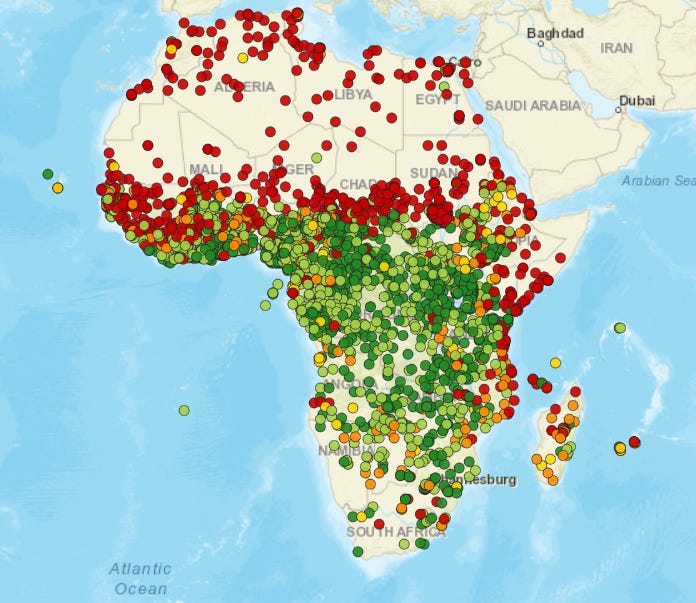
Our team just ran a fresh analysis of Africa’s Frontier People Groups on late-July 2026 Joshua Project data. Frontier peoples are the hardest edge of the unreached: 0.1% or fewer Christian adherents and no known movement to Jesus.
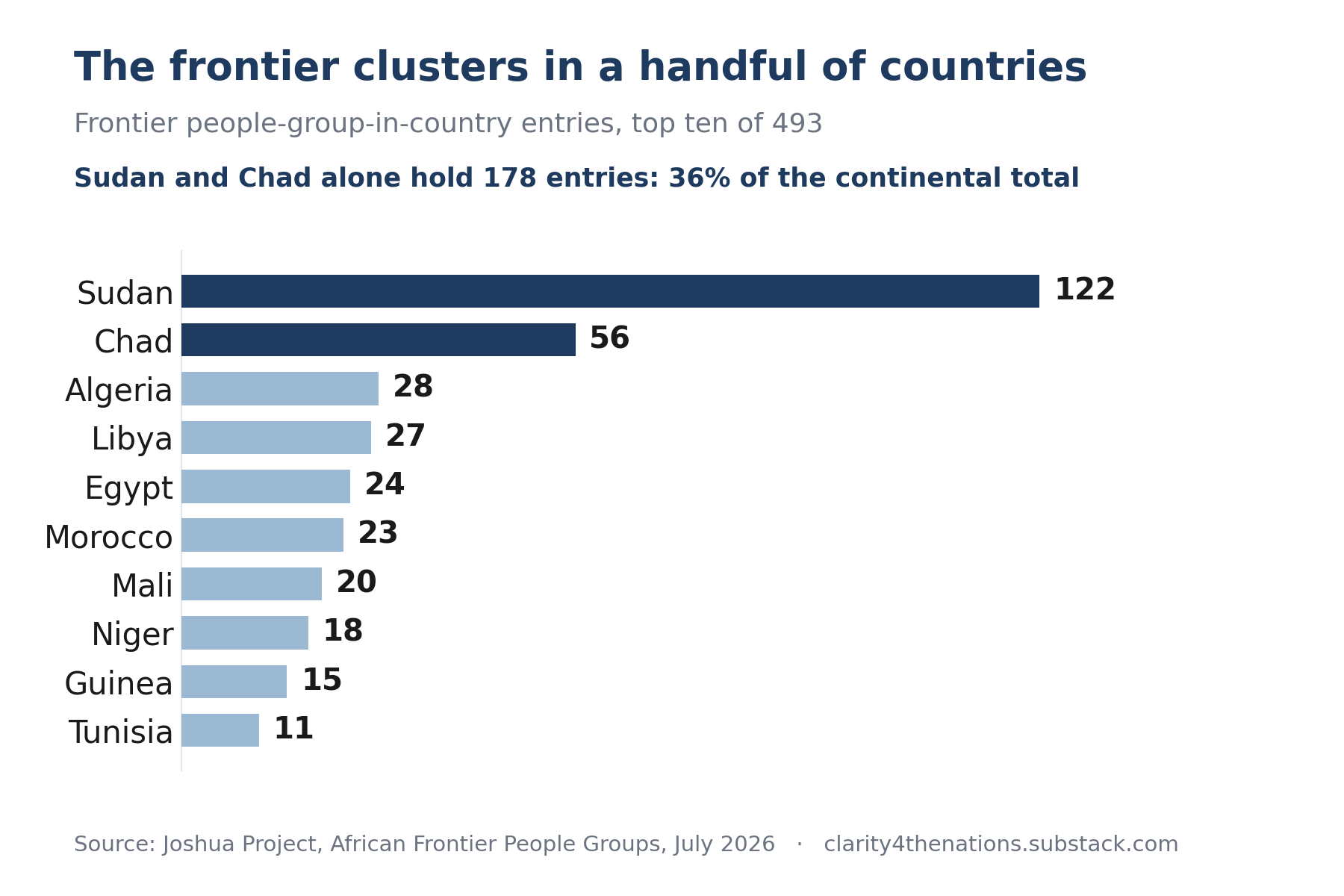
It forms one contiguous belt. The frontier runs from the Atlantic coast, across the Sahel and Sahara, up the Nile River Valley, and into the Horn of Africa. That is 493 people groups spanning 49 countries and 222 million people, counting each group once per country it lives in. The need clusters specifically in a few areas: Sudan alone holds 122 of these groups, and Sudan and Chad together account for more than a third of the continental total.
They are Muslim. Ninety-seven percent of these people groups are Muslim. There is no significant Hindu, Buddhist, or secular frontier population here. This is a Muslim-world assignment.
The workers aren’t there yet. Counted as distinct peoples rather than country by country, the belt holds 300 frontier groups. Of those, 194 sit at Engagement Phase 0: no known ongoing gospel engagement. For roughly two-thirds of these peoples, we are not aware of any cross-cultural worker focused on establishing self-sustaining churches. This is partly a gap in activity, but also a gap in our knowledge of activity already being championed by African believers. Not all of that has made its way to Joshua Project yet.
The challenge splits into two extremes. Return to the full count of 493 for a moment. Five massive groups above ten million people hold more than half the frontier population. They have translated Scripture and media, and they sit behind severe access barriers. But physical access is only the first wall. These populations live inside religious strongholds where Islam is not just a belief system but the fabric of family, law, economy, and identity. Government, community, and household stand together against anyone who turns to Christ.
Available Scripture does not mean a reached people.
Where the gospel has been received, believers are expelled from every relationship they have and often face real danger. Somalia, Sudan, and Libya all rank in the top ten worldwide for persecution. So even when a worker gets in, the response is slow, costly, and hidden.
On the other end, 320 people groups under 100,000 people face a severe resource shortage, and among the smallest of them nearly half have no translated Scripture at all. The giants have resources without openness. The small have no resources to gauge their receptivity.
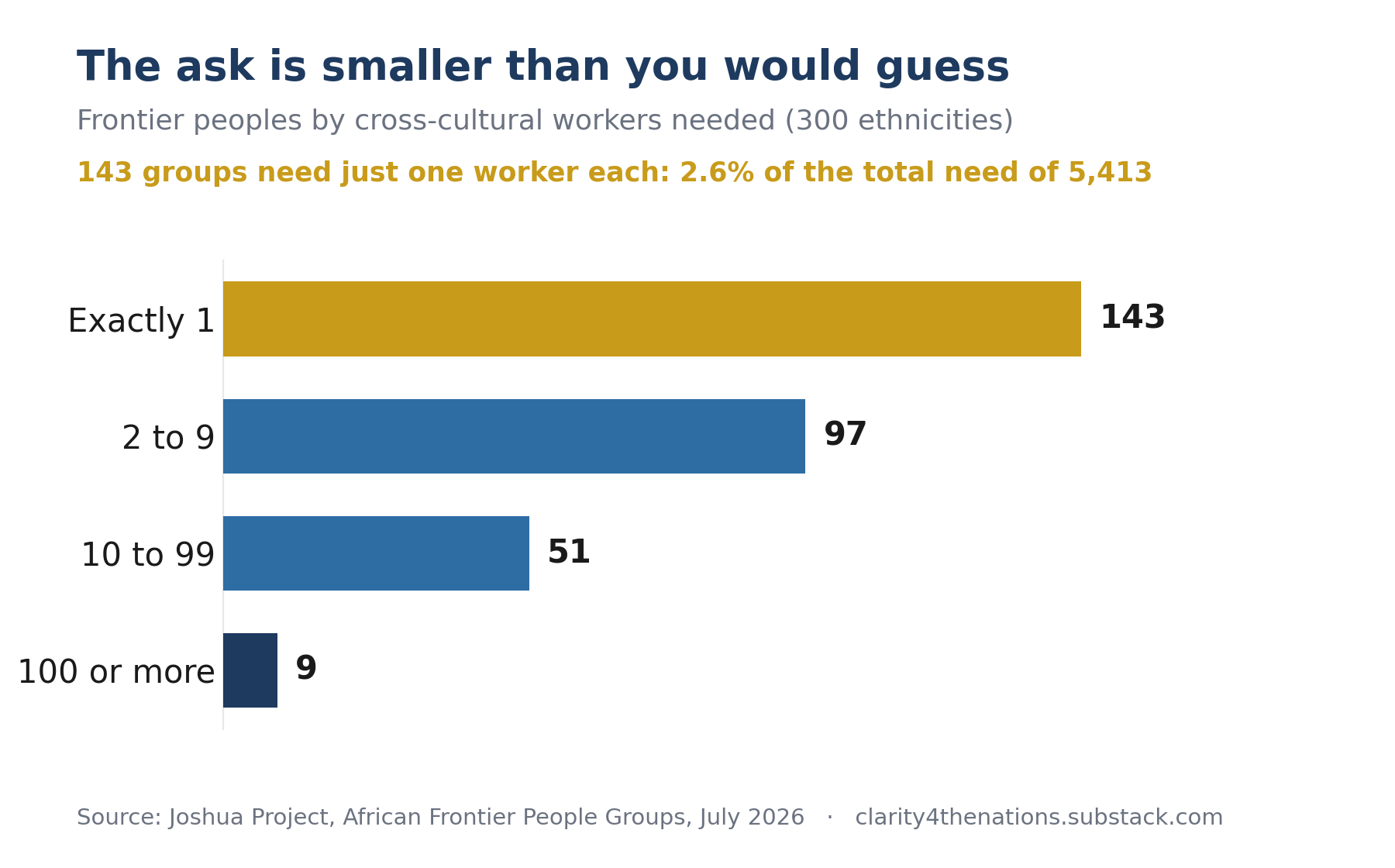
And the ask is smaller than you would guess. For 143 of these people groups, the need is exactly one cross-cultural worker. A single family, prepared and sent, closes the engagement gap for an entire people.
The math clear.
Look at how close the church already sits to these groups.
Country Evangelical believers (est.) Nigeria ~65 million DR Congo ~22 million Kenya ~27 million Ghana ~9 million
Add the growing evangelical communities across Francophone West Africa, from Burkina Faso and Côte d’Ivoire to Benin, Togo, and Cameroon, and the believing church within a two-day bus ride of the Sahel frontier runs well north of 130 million.
That proximity is not only geographic. It is cultural and linguistic, and the data shows the bridges already standing:
Hausa is the primary language of nine frontier people groups, and the wider Hausa-speaking world already holds a real evangelical presence across 16 countries. Nigerian believers share markets, borders, and a trade language with frontier peoples in Niger and Chad.
Swahili is the primary language for 16 frontier people groups, and the broader Swahili-speaking community is well evangelized. Kenyan and Congolese believers already share that language with frontier populations along the East African coast. No new translation is required to send them.
Chadian and Sudanese Arabic carry small but genuine believing communities that sit closer to the largest frontier language blocks than any Western sender ever will.
A church planter from Jos or Kinshasa or Nairobi starts from a stronger position. Shared climate, shared economics, adjacent cultures, sometimes a shared tongue.
What a Western worker spends years acquiring, a near-culture African worker often carries from birth.
The bottleneck is training, not people
The data confirms the need. The evangelical communities confirm the proximity, but none of those facts guarantees its effectiveness.
An unprepared worker in the Sahel will not last, and the frontier is littered with well-meant efforts that entered and then withdrew. The data confirms why. Methods built for animist contexts or built on a cultural view of Christianity do not transfer to societies where faith, family, and legal identity are one fabric and following Jesus costs a person everything.
Sending near-culture workers without cross-cultural training only moves the failure point closer to the field.
Proximity buys a head start on language and climate. It does not buy readiness for a religious stronghold.
So the need is clear. We need competent, confident, cross-cultural church planters, equipped and released at scale by the African church itself.
That is why later this month our team is heading to West Africa to lead a research and strategy training with national partners: hands-on work with people group data, field research methods, and engagement strategy. The aim is not to teach a seminar. It is to transfer a skill set, so that African researchers and mobilizers can run this analysis themselves, find their own nearest frontier peoples, and equip their own senders without waiting on anyone overseas. (Read my debrief of that training from the Abuja Airport HERE.)
Build the framework, hand over the keys, and measure success by what keeps going after you leave.
What remains
The Great Commission in Africa does not need to wait for outside resources. Those resources already sit in the pews of Lagos, Kinshasa, Nairobi, Accra, Abidjan, and a thousand cities in between. What remains is for the church to look at the map, count the cost, and send.
Before your team mobilizes to Africa, three questions are worth putting on the table:
What percentage of your network/org/team’s frontier people group focus in Africa is being worked by near-culture African workers versus Western workers?
Does your team have a formal pathway for receiving and equipping African near-culture senders? If not, what will it take?
Which frontier groups in your current focus sit within reach of an established Hausa, Swahili, or Chadian Arabic-speaking evangelical community?
How are you equipping and partnering with the African missions sending force for effectiveness and not dependence?
Data: Joshua Project People Group Data team, African Frontier People Groups brief, 31 July 2026. Evangelical counts drawn from Joshua Project country data (joshuaproject.net), retrieved August 2026. More at joshuaproject.net/frontier.
Bud Houston serves as Director of People Group Data at Joshua Project and writes Clarity for the Nations on Substack.
Good information to pray about and when possible, to act upon. Thanks so much.